Concluding our series on custom CRM development, I want to address the most critical question — security. When you trust a system with client data and financial reports, you need to understand who can access it and how it is protected.
In this article, we’ll break down how to ensure data protection and how self-hosting provides more control while also increasing responsibility.
In this article:
- Data Control: SaaS vs. Self-hosted Comparison
- Docker Isolation and Its Limits
- Backup Strategy: The 3-2-1 Rule
- Infrastructure Cost of Ownership
1. Data Control: Your Server — Your Rules
With cloud CRM, part of the security and infrastructure responsibility rests with the provider. Self-hosting gives the company more control, but also requires it to manage protection, updates, and recovery. Neither model is inherently safer.
In a custom system, we implement:
- Segmentation: External access is limited to necessary components; administrative interfaces are protected.
- TLS: Encryption of traffic between the browser and server.
- Access Control: PostgreSQL is not exposed to the internet, permissions are checked on the backend, and administrative actions are logged.
2. Docker and System Mobility
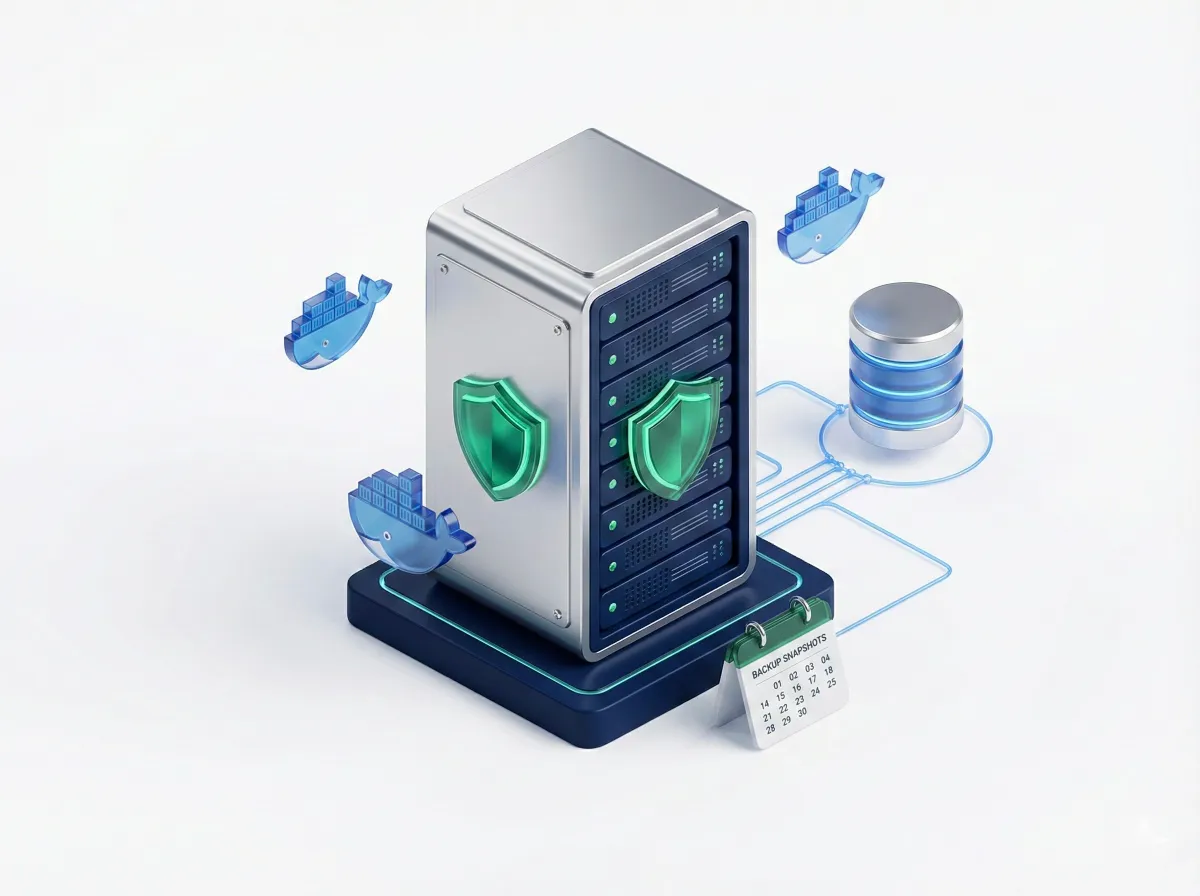
We use Docker to “package” the CRM into an isolated container.
- Hosting Independence: Reproducible environments simplify migration, but the time depends on data, configuration, DNS, and testing.
- Environment Purity: Minimal images, non-root execution where possible, regular updates, and secret management reduce the attack surface. Containers alone do not guarantee security. This is part of our development principles.
3. Backups: The 3-2-1 Rule and Recovery
We implement an automatic backup system:
- 3-2-1 Rule: Three copies of data (including the working copy), two types of media or independent storage systems, and one copy offsite.
- Backup Frequency: The acceptable data loss (RPO) determines frequency. Daily backups without more frequent copies may mean losing up to a day of changes; PostgreSQL WAL archiving and point-in-time recovery (PITR) can be used when needed.
- Recovery: Verify backups, test restoration, encrypt copies, and restrict backup access separately. Agree on and test the acceptable downtime (RTO).
4. Budget Server or Own Hardware?
Costs depend on workload and reliability requirements:
- High-Performance VPS: A budget VPS may be enough for a small team; sizing depends on workload and availability requirements.
- Own Hardware: Avoids VPS rental but still requires electricity, maintenance, updates, and backups.
Conclusion: Custom CRM is Freedom
It’s a tool that grows with you, doesn’t require subscription fees for every new employee, and operates by your rules.
Want to move from the cloud to a secure, private system? Message me on Telegram—I’ll perform a technical audit of your current setup and propose a secure data migration plan.
Read also: Tech Stack for Modern CRM and ERP