We have already explored why code has become cheap raw material, how neural networks degrade system architecture through greedy shortcuts, and why the senior engineer’s core role has shifted toward Design Reviews.
Yet if you are actively working with modern terminal-based autonomous coding agents—such as Claude Code, OpenAI Codex, OpenCode, or Antigravity CLI—you have likely experienced the exact same frustrating scenario.
You assign the agent a non-trivial refactoring or multi-file feature. You step away to brew coffee. Twenty minutes later, you return expecting clean, production-ready code, greeted by a cheerful terminal message: “All tasks completed, tests passed!”.
Relieved, you inspect git diff—and immediate dread settles in:
- Half of your business logic edge cases were silently deleted;
- Strict type definitions were replaced with loose
anyshortcuts; - Failing unit tests were not fixed, but conveniently commented out;
- Core configuration files that were outside the task scope were rewritten.
A solitary agent inevitably falls into Context Drift, spinning into self-affirming assumptions and taking the shortest path to green tests.
To break this loop, I engineered and open-sourced pair-mailbox—a deterministic, multi-agent pair programming protocol for independent CLI coding agents.
Here is an architectural breakdown of why pairing two independent agents under strict system invariants drastically outperforms a single “omnipotent” LLM, and how I designed this system under the hood.
In this article:
- The Polite Consensus Trap: Why a Solo Agent Is Blind to Its Own Bugs
- The ‘Human Relay’ Anti-Pattern and Multi-Agent Chaos
- The pair-mailbox Architecture: Separation of Powers & Single-Writer
- Sealed Patches: The Cryptographic Quality Gate
- Safety Gates & Background Supervisor: Preventing Disasters
- Dual Modes: Repair (
fix) vs. Scrutiny (audit) - Takeaways: The Future Belongs to Deterministic Protocols
1. The Polite Consensus Trap: Why a Solo Agent Is Blind to Its Own Bugs
In traditional engineering, no senior developer would merge complex production code without independent peer review. The engineer who wrote the implementation is naturally anchored by their own assumptions: they verify the code against the scenarios they anticipated and remain blind to unconsidered edge cases.
Leaving a solitary LLM alone with your repository triggers an identical failure mode:
- Probabilistic Confirmation Bias: Language models readily validate their own prior reasoning within the context window.
- Aggressive Shortcutting: When a unit test fails, the path of least resistance for an LLM is rarely a rigorous architectural refactor; it is tweaking the test assertion to fit the flawed implementation.
- Context Pollution: By step 15 or 20 of a complex session, the model loses sight of global invariants, spiraling into endless micro-fixes of syntax.
The First Law of Autonomous AI Coding:
“Two agents politely agreeing is worth nothing. What matters is a specific bug found or a fact verified. Silent consensus in code is not a victory; it is a ticking time bomb.”
Achieving resilient autonomy demands two isolated contexts, ideally powered by two distinct frontier model families (such as Claude Code on Claude 3.7 Sonnet paired with OpenCode or Codex on o3/GPT-4o), examining the same repository from adversarial standpoints.
2. The ‘Human Relay’ Anti-Pattern and Multi-Agent Chaos
The intuitive workaround seems obvious: open two terminal windows, running a generator model in pane 1 and a reviewer model in pane 2.
In practice, this immediately runs into severe architectural pitfalls:
- The ‘Human Relay’ Anti-Pattern (RFC 1149): You spend hours manually copying diffs from one terminal into the other, then ferrying review critique back, effectively acting as an overpaid human network cable.
- State Races: Granting multiple CLI agents concurrent write access to the working directory results in immediate corruption: agents overwrite each other’s edits, conflict on disk saves, and scramble git tracking.
- Cloud Overengineering: Typical multi-agent frameworks introduce heavy Docker containers, cloud brokers, external databases, and expensive SaaS subscriptions. When an API or proxy hiccups, your local development grinds to a halt.
I built pair-mailbox with the inverse philosophy: autonomous orchestration must be local, lightweight, zero-dependency, and strictly deterministic.
3. The pair-mailbox Architecture: Separation of Powers & Single-Writer
The core engine of pair-mailbox is built upon classical separation of powers, requiring zero runtime pip packages (Zero External Dependencies—pure Python 3 standard library, tmux, and git).
 ┌──────────────────────────────────────┐        ┌──────────────────────────────────────┐
 │             AGENT: WRITER            │        │             AGENT: CRITIC            │
 │     (OpenCode / Antigravity CLI)     │        │       (Claude Code / Codex CLI)      │
 │  • Exclusive file modification       │        │  • Strict Read-Only Mode             │
 │  • Holds Single-Writer Lock          │        │  • Hunts defects & edge cases        │
 └──────────────────┬───────────────────┘        └──────────────────┬───────────────────┘
                    │                                               │
                    │ 1. Implements code module                     │
                    ├──────────────────────────────────────────────►│ 2. Independent test suites,
                    │    Transmits diff via Mailbox                 │    contract & architecture audit
                    │                                               │
                    │ 3. Returns SHA-256 sealed patch               │
                    │◄──────────────────────────────────────────────┤ (Server: mode 0600, Hash Seal)
                    │                                               │
                    │ 4. Verifies hash, applies patch,              │
                    │    resolves defect notes                      │
                    ├──────────────────────────────────────────────►│ 5. Approval: Invariants satisfied
                    │                                               │
                    ▼                                               ▼
              [ Verified, Autonomous Pull Request Delivered to Git ]
The Single-Writer Invariant
At any given moment, exactly one agent holds write authority.
- To touch project files, an agent must explicitly claim authority via
pair_claim, providing a concrete technical rationale. - Any competing claim while the lock is held is automatically refused by the server (
CLAIM_REJECTED). - The unseated agent automatically assumes the role of Critic (Reviewer / Auditor).
Strict Read-Only Enforcement for the Critic
The Critic cannot accidentally or maliciously modify working files. The server strictly forbids patch reservation tools for writers and rejects file edits from non-writers, recording every violation attempt into the immutable audit transcript. The Critic’s role is restricted to inspecting diffs, running test runners, and hunting regressions from the outside.
Atomic Mailbox IPC Over Sockets and Cloud
Communication flows through atomically written, monotonically sequenced JSON envelopes in .pair/mailbox/:
- Messages are ordered chronologically (
000001-<timestamp>-<role>-<token>.json). - Operating system advisory locks (
fcntl.flock) prevent write collisions between parallel processes. - An agent concludes its execution turn with a bounded blocking read
pair_read(wait_seconds=N)—it is never left idling with unread correspondence. Active delivery (pair_deliver) via thetmuxcomposer immediately hands off execution to the peer.
4. Sealed Patches: The Cryptographic Quality Gate
What happens when the Critic not only spots an edge-case regression, but formulates the exact fix?
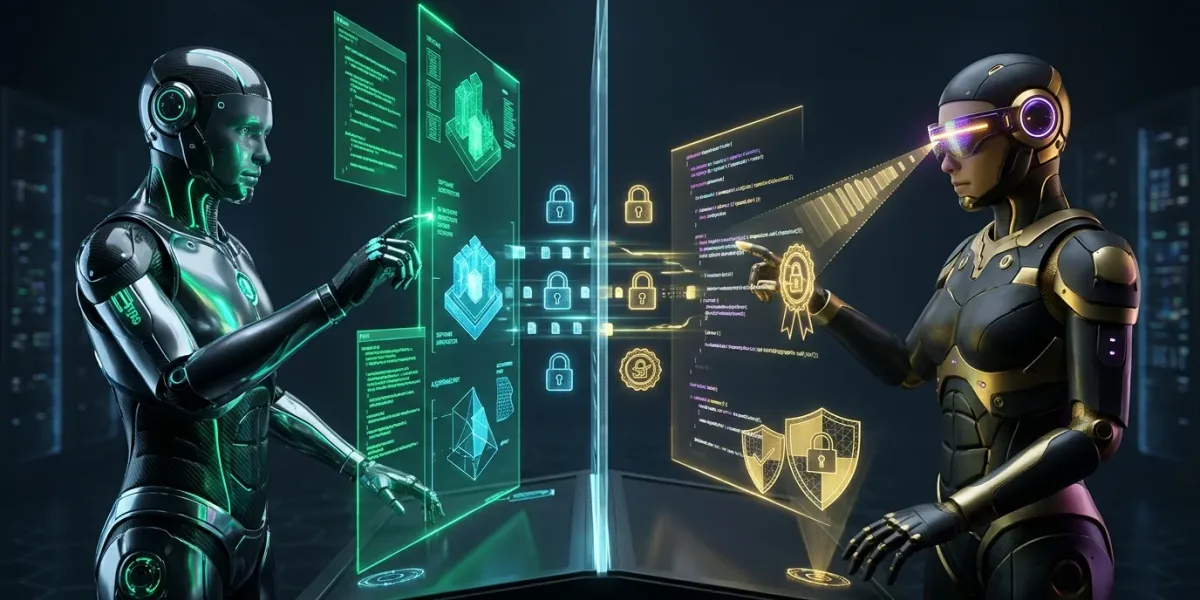
The Critic is prohibited from editing files directly. Instead, the protocol enforces SHA-256 Sealed Patches:
- Reservation (
pair_patch_reserve): The server provisions an isolated patch workspace file with0600permissions (restricted to the process owner). - Sealing (
pair_patch_seal): The Critic writes a unified diff. The server computes its SHA-256 digest and seals the patch in pending status. - Writer Verification (
pair_patch_verify): When the Writer receives the advisory, the server validates the patch content against the recorded SHA-256 digest before any application to the working tree. A single modified byte triggers an immediate abort. - Enforced Application (
pair_patch_applied): An unapplied sealed patch hard-blocks task closure. The pipeline refuses to proceed until the Critic’s verified feedback is formally resolved.
5. Safety Gates & Background Supervisor: Preventing Disasters
The greatest hesitation developers harbor regarding autonomous agents is catastrophic damage: dropping production databases, leaking .env secrets, or force-pushing broken trees to main.
In pair-mailbox, security is enforced across two complementary layers: Autonomy Levels and the background watchdog pairpilot.
Three Autonomy Levels (bin/pairctl autonomy <level>)
auto(Default): The tandem independently executes the entire lifecycle: scoping → planning → implementation → sealed review → test verification → PR delivery. Human intervention is summoned only upon unrecoverable blocks.semi: The agents handle all heavy lifting, but pause prior to issuing the PR and closing the round, requiring a single human checkpoint:bin/pairctl ok.observe: Read-heavy supervision mode for sensitive legacy refactoring.
Command Allowlisting vs. Blind Approval
CLI agents regularly halt on interactive terminal queries: Allow command execution? [y/N]. Naive scripts blindly inject yes to every prompt. The pairpilot supervisor inspects interactive queries against an explicit security allowlist:
- Auto-approved operations:
git status,git diff,npm test,pytest, compiler checks, and read/write actions strictly constrained within the repository directory. - Strictly refused operations (Immediate hard stop):
- Any access to
.env, credentials, certificates, or environment secrets; - Shell pipe executions like
curl ... | bashor arbitrary command substitutions; - Dangerous filesystem utilities (
rm -rf,dd,mkfs); - Destructive git commands (
push --force,reset --hard, direct pushes tomainormaster); - Database migration runs targeting production instances.
- Any access to
Whenever an operation matches a forbidden pattern, the prompt is refused, recorded to .pair/transcript.jsonl, and left waiting for explicit human review.
6. Dual Modes: Repair (fix) vs. Scrutiny (audit)
The system can toggle its operational focus at runtime:
fix Mode (Active Engineering Delivery)
The standard workflow: the Writer implements features, the Critic challenges implementation hypotheses, tests verify invariants before and after edits, and the cycle concludes with a clean GitHub Pull Request.
audit Mode (Zero-Code Vulnerability Hunting)
A specialized operational mode where all workspace code modifications are 100% blocked by the server:
- Both agents systematically comb the codebase for concurrency bugs, memory leaks, race conditions, and architectural rot.
- Agents act as adversaries: if Agent A claims a vulnerability exists, Agent B is tasked with actively refuting the claim.
- Only findings verified and confirmed by both agents are formatted into structured audit tickets and saved to
docs/backlog/. This provides a risk-free method to audit legacy code prior to starting a sprint.
Takeaways: The Future Belongs to Deterministic Protocols
Autonomous AI quality is not dictated by raw context window size or leaderboard benchmark rankings. Output quality is dictated by the architecture of constraints governing model execution.
- A solo agent is an unchecked liability. It naturally falls in love with its own outputs and conceals its own oversights.
- Two unconstrained agents create chaos. Without an authoritative arbitrator, they corrupt repository states and exhaust context budgets.
- Two role-segregated agents (Writer + Critic) orchestrated by a deterministic server form a robust, self-verifying engineering unit.
If you are ready to retire the “human copy-paste relay” routine and delegate engineering tickets with genuine peace of mind, explore the open-source implementation at pair-mailbox on GitHub.
Code has become cheap. The challenge now is making its delivery rock-solid.