For 10 years in development, I’ve seen how technologies died and were born, but now we are at a special point. AI is not just another library or framework. It’s a new type of relationship with information. And if you decide to ignore it, you will find yourself in the position of a person trying to row across the ocean while a jet plane flies by.
But there is a catch: you need to know how to fly this plane, otherwise you will just crash into a mountain faster.
Lesson One: Leipzig and the Complexity of the World
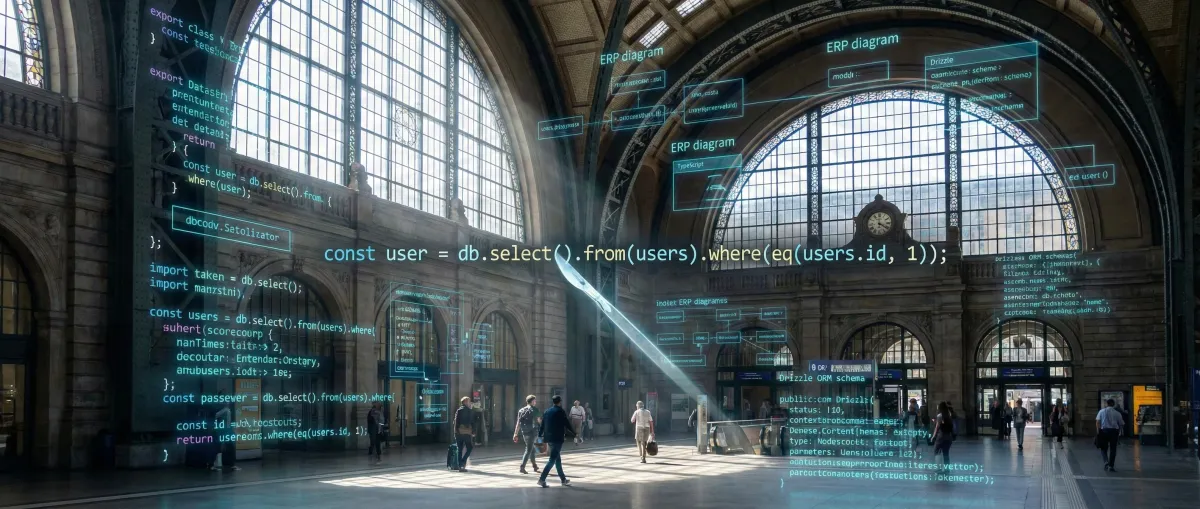
Imagine: you are standing in the middle of the railway station in Leipzig. It is one of the largest multi-level stations in Europe. Dozens of tracks, transitions, signs, noise - your brain simply stops processing this flow at some point. You are lost in physical space and in the abundance of options.
I just explained the situation to AI, showed where I needed to get to, and asked to sort out this chaos. A second later, I got not just a route through levels and escalators, but a step-by-step plan: exactly which ticket I needed out of a dozen options, which one would be cheaper, and how to buy it correctly right now so as not to overpay the German railways. AI didn’t “solve the problem for me”, it became a navigator that removed unnecessary noise and left only the shortest path to a profitable goal.
In modern IT, we stand at such a “station” every day. The amount of technologies, documentation, and legacy code exceeds the capabilities of human memory. To ignore AI in such conditions means voluntarily choosing the path of a blind kitten.
Lesson Two: The Price of a Single Letter in Drizzle ORM
But friendship with AI is not blind trust. Recently, while working on a complex ERP system, I was updating the functionality and database schema via Drizzle. A roadblock, a couple of hours of thought, and I asked AI to help with refactoring a complex schema.
The machine gave a beautiful, logical solution. But in the process, it “decided” that the name of a user role in the database should start with a different letter or have a different case. A trifle? In the world of SQL, strict typing, and migrations, this is a catastrophe.
I trusted it, didn’t check the diff thoroughly, and clicked “apply”. The result was deleted information from related tables, system panic, and two hours of my life untangling this blunder and restoring data from a backup. Fortunately, this was a test run, not production.
Conclusion: Working with AI should be like a surgeon working with a scalpel. One clumsy movement, one overlooked symbol - and you cut into the living flesh.
Why Do We Lose Vigilance?
People often try out AI on something small - writing a simple script or formatting JSON. It works out pretty well, and an illusion of safety arises. But this is exactly where the main danger lies:
-
Lack of structure and protection. Even on small tasks, beginners often “slap together” code without understanding the architecture. They copy solutions that work in the moment but plant a ticking time bomb under a future project.
-
Data leaks. In a fit of enthusiasm, people leak secrets, access keys, database structures, and confidential logic into chats with AI, which can later surface in repositories or training samples.
-
Hallucinations. AI lies confidently. It can invent a library method that doesn’t exist or “quietly” change a data type. Without strict control, you simply multiply errors.
How to Properly “Befriend” Progress?
My philosophy over 10 years of practice: AI is a powerful assistant, but its value is directly proportional to your experience. For a professional, it’s not a struggle with the tool, but a process of conscious curation.
- Architectural vision. When you understand the structure of the system, checking code from AI becomes an automatic process. You don’t just look at the lines, you see how they fit into the overall logic and security.
- Delegating routine, not responsibility. AI is great at writing boilerplate code, complex regular expressions, or SQL queries. But the final decision always remains with your experience - you validate the result based on your understanding of the project.
- Security as an instinct. An experienced engineer doesn’t wait for a catch, they eliminate it. Checking field names, cases, and data types in Drizzle or any other ORM is mandatory hygiene that saves hours recovering backups.
Conclusion
Progress cannot be ignored. It must be saddled. Use AI as a navigator so as not to get lost at the “station” of complexity, but never let the scalpel out of your hands when it comes to live code.
In the end, you are responsible for the result, not the algorithm.
P.S. In the next article, I will explain in detail how AI helped me bring a project I had been building for years closer to the finish line. With the advent of neural networks, development accelerated so much that the long-term construction, which seemed endless, is finally nearing release.
Do you want to optimize your project using modern tools safely? Contact me on Telegram — I will conduct a technical audit and show you how to accelerate your business with minimal risk.
Read also: Template vs Custom: Choosing the Right Approach for Your Project